The EBAM–AOIS Canonical Framework
The Foundational Architecture for Adaptive Alignment, Organizational Intelligence, and Purposeful Business Evolution.
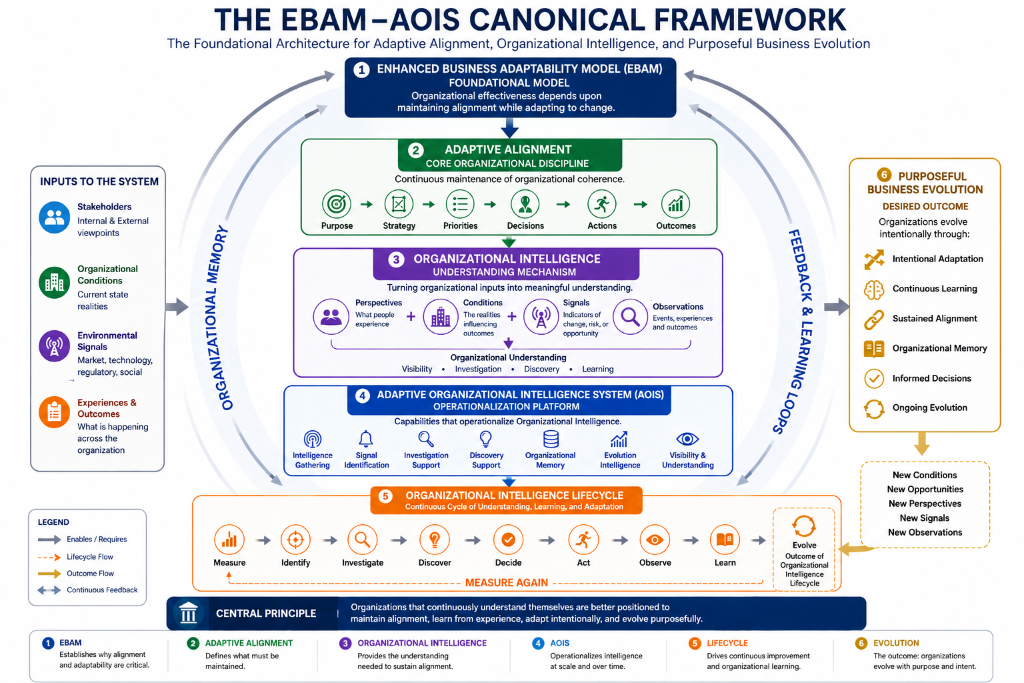
Figure 1: The EBAM–AOIS Canonical Framework — the governing architectural reference for the AOIS ecosystem.
What Is the EBAM–AOIS Canonical Framework?
The EBAM–AOIS Canonical Framework is the foundational architecture that defines how organizational inputs become understanding, how understanding supports intentional decisions and actions, how learning is preserved through Organizational Memory, and how sustained intelligence enables purposeful business evolution. It is the governing reference for all AOIS concepts, lifecycle stages, and capabilities.
1. Enhanced Business Adaptability Model (EBAM)
The conceptual framework that informs adaptability, alignment, and organizational evolution.
The foundational premise is that organizational effectiveness depends upon maintaining alignment while adapting to change. Organizations face continuous tension between stability (the structures, processes, and strategies that create consistent value) and adaptability (the capacity to respond to new conditions, signals, and opportunities). EBAM provides the conceptual foundation for understanding this tension — and for developing the organizational capabilities to navigate it.
Foundational Model
EBAM is the conceptual layer. It does not operationalize — it informs. AOIS is the platform that makes the concepts operational. Together, they form a complete architecture for organizational intelligence.
2. Adaptive Alignment
Adaptive Alignment is the core organizational discipline — the continuous maintenance of organizational coherence.
It flows through six operational elements:
Purpose
Why the organization exists and what it is ultimately working to achieve.
Strategy
How the organization intends to create value and achieve its purpose.
Priorities
What the organization focuses on now — the initiatives, resources, and attention that drive progress.
Decisions
The choices the organization makes about direction, resource allocation, and action.
Actions
What the organization does — the initiatives, programs, and operations that produce outcomes.
Outcomes
What results — the effects of decisions and actions on organizational performance and evolution.
3. Organizational Intelligence — The Understanding Mechanism
Organizational Intelligence is the understanding mechanism — turning organizational inputs into meaningful understanding.
Organizational Intelligence Constructs
These are informational inputs and outputs — NOT lifecycle stages.
Perspectives
What people experience — internal and external viewpoints.
Conditions
The realities influencing outcomes — current state realities.
Signals
Indicators of change, risk, or opportunity — market, technology, regulatory, social.
Observations
Events, experiences, and outcomes — what is happening across the organization.
Output
Organizational Understanding
Visibility · Investigation · Discovery · Learning
4. AOIS — The Operationalization Platform
An Organizational Intelligence Platform that helps organizations measure alignment, investigate organizational signals, preserve learning, and support purposeful business evolution.
AOIS operationalizes Organizational Intelligence through seven integrated capabilities:
5. The Organizational Intelligence Lifecycle
The lifecycle is a continuous cycle of understanding, learning, and adaptation — eight stages through which organizational intelligence flows.
Measure
Organizational inputs are gathered and quantified.
Identify
Patterns, signals, and conditions are recognized.
Investigate
Patterns are explored in context.
Discover
Understanding expands. Relationships become visible.
Decide
What action to take is determined.
Act
Informed action is taken.
Observe
Outcomes are watched and recorded.
Learn
Learning is extracted and preserved.
Lifecycle Outcome
Evolve
The organization moves forward purposefully — the outcome the full lifecycle enables.
Organizational Memory — The Feedback Mechanism
Organizational Memory preserves signals, discoveries, observations, decisions, and learning across the full lifecycle. It is a capability and preservation mechanism — not a lifecycle stage.
Organizational Memory preserves:
Organizational Memory is a capability — NOT a lifecycle stage. It operates as a cross-cutting feedback mechanism across the entire architecture, preserving organizational understanding so that learning compounds rather than resets with each change in initiative, leadership, or strategy.
6. Purposeful Business Evolution — The Desired Outcome
Purposeful Business Evolution is what the entire ecosystem enables — organizations evolving intentionally through:
Central Principle
Organizations that continuously understand themselves are better positioned to maintain alignment, learn from experience, adapt intentionally, and evolve purposefully.
AOIS Provides Organizational Intelligence. Organizations Determine Their Own Evolution.
AOIS helps organizations understand. It reveals hidden friction, supports investigation, enables discovery, and preserves learning through Organizational Memory. Organizations remain fully responsible for their decisions, actions, learning, and evolution. The intelligence belongs to the organization — always.
Part of the AOIS Organizational Intelligence Resource Center · Canonical architectural reference
Begin Your Organizational Intelligence Journey
Explore what AOIS may reveal about the dimensions and conditions influencing your organization.