Why Organizations Need Organizational Intelligence
The Origins and Architecture of the EBAM–AOIS Canonical Framework
 ×AAG
×AAGExecutive Summary
Organizations possess more information than ever before.
Yet many struggle to answer basic questions: What is actually happening across the organization? Why do initiatives stall despite good intentions? Where does misalignment originate? How can organizations evolve intentionally instead of reactively?
The challenge is not information scarcity.
The challenge is organizational understanding.
Traditional approaches — collecting data, conducting surveys, measuring outcomes, tracking performance — often fail to create shared understanding.
This whitepaper explores the origins of the EBAM–AOIS Canonical Framework and the architecture that makes purposeful business evolution possible.
Part I
The Problem
Information Is Not Understanding
Organizations collect metrics, dashboards, employee feedback, customer insights, market intelligence, and financial reports. Yet leaders frequently experience conflicting perspectives, invisible misalignment, repeated transformation failures, fragmented understanding, and reactive decision-making.
Information alone does not produce understanding. Understanding must be developed.
The Tension Between Stability and Change
Organizations must simultaneously preserve what works and adapt to changing conditions.
Too Much Stability
Creates rigidity. The organization holds form but cannot respond to changing conditions.
Too Much Adaptability
Creates chaos. The organization responds constantly but loses coherence and direction.
The challenge is maintaining alignment while adapting continuously. This tension became the starting point for EBAM.
Part II
The Origins of the Framework
Enhanced Business Adaptability Model (EBAM)
EBAM emerged from a simple observation:
Organizational effectiveness depends upon maintaining alignment while adapting to change.
Alignment and adaptability are not opposing forces. They are complementary capabilities. Organizations must continuously balance purpose, strategy, priorities, decisions, actions, and outcomes — while responding to new conditions, emerging signals, and changing realities.
EBAM became the conceptual foundation. But a new question emerged:
How do organizations operationalize these ideas?
Part III
Why Organizational Intelligence Matters
Organizations are constantly exposed to perspectives, conditions, signals, and observations.
Perspectives
What people experience — internal and external viewpoints.
Conditions
The realities influencing outcomes — current state realities.
Signals
Indicators of change, risk, or opportunity — market, technology, regulatory, social.
Observations
Events, experiences, and outcomes — what is happening across the organization.
Individually these are fragments. Together they become Organizational Intelligence — transforming inputs into visibility, investigation, discovery, and learning.
Organizational Understanding: Visibility + Investigation + Discovery + Learning — turning organizational inputs into meaningful understanding.
Understanding becomes an organizational capability.
Part IV
Introducing the EBAM–AOIS Canonical Framework
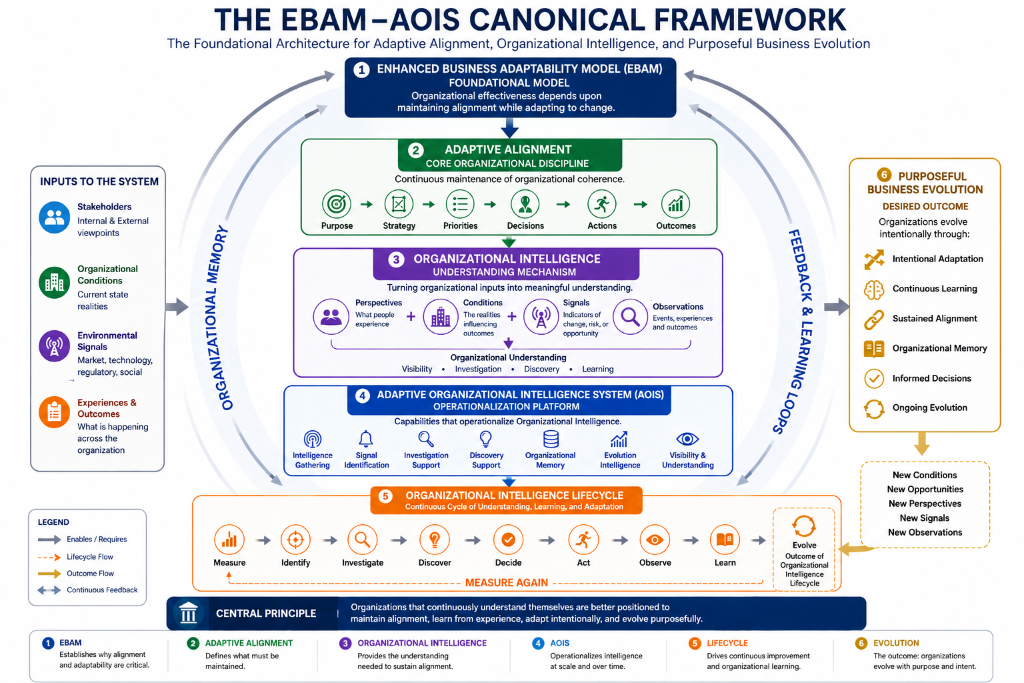
Figure 1 — The EBAM–AOIS Canonical Framework: foundational architecture for Adaptive Alignment, Organizational Intelligence, and Purposeful Business Evolution.
EBAM
The conceptual foundation. EBAM establishes the principle that organizational effectiveness depends upon maintaining alignment while adapting to change.
Adaptive Alignment
The organizational discipline maintaining coherence between Purpose, Strategy, Priorities, Decisions, Actions, and Outcomes. Alignment is not a one-time event — it is a continuous activity requiring visibility, shared understanding, coordinated decision-making, and intentional adaptation.
Organizational Intelligence
The understanding mechanism. Turning perspectives, conditions, signals, and observations into visibility, investigation, discovery, and learning.
AOIS
The operational platform. AOIS operationalizes Organizational Intelligence through Adaptive Exploration, Investigation Support, Discovery Support, Organizational Memory, Evolution Intelligence, and Visibility & Understanding.
AOIS helps organizations understand. Organizations remain responsible for deciding, acting, learning, and evolving.
The Organizational Intelligence Lifecycle
Eight stages — Measure, Identify, Investigate, Discover, Decide, Act, Observe, Learn — that continuously repeat.
Evolve — The outcome of the full lifecycle. The organization moves forward purposefully — the outcome the full lifecycle enables.
Part V
Organizational Memory
Most organizations lose understanding faster than they create it. People leave. Initiatives change. Strategies evolve. Learning disappears.
Organizational Memory exists to preserve signals, discoveries, observations, decisions, and learning. It is not a lifecycle stage, not a database, not an archive. It is a capability that enables learning to compound over time.
Organizational Memory preserves what organizations learn so understanding never starts from zero.
Part VI
Purposeful Business Evolution
Purposeful Business Evolution is the outcome the architecture enables. Organizations evolve intentionally through Intentional Adaptation, Continuous Learning, Sustained Alignment, Organizational Memory, Informed Decisions, and Ongoing Evolution.
Intentional Adaptation
Continuous Learning
Sustained Alignment
Organizational Memory
Informed Decisions
Ongoing Evolution
Evolution is not disruption.
Evolution is not starting over.
Evolution is the intentional accumulation of understanding over time.
The Central Principle
"Organizations that continuously understand themselves are better positioned to maintain alignment, learn from experience, adapt intentionally, and evolve purposefully."
Final Positioning
The EBAM–AOIS Canonical Framework is not a consulting methodology, a survey, a questionnaire, or a diagnostic tool.
It is a foundational architecture, an Organizational Intelligence model, a framework for continuous understanding, and a guide for purposeful business evolution.
Organizations do not need to start over. They need better understanding. The EBAM–AOIS Canonical Framework provides the architecture that makes that understanding possible.
Adaptive Organizational Intelligence for Purposeful Business Evolution
Measure. Identify. Align. Evolve.
Stop starting over. Start moving forward.